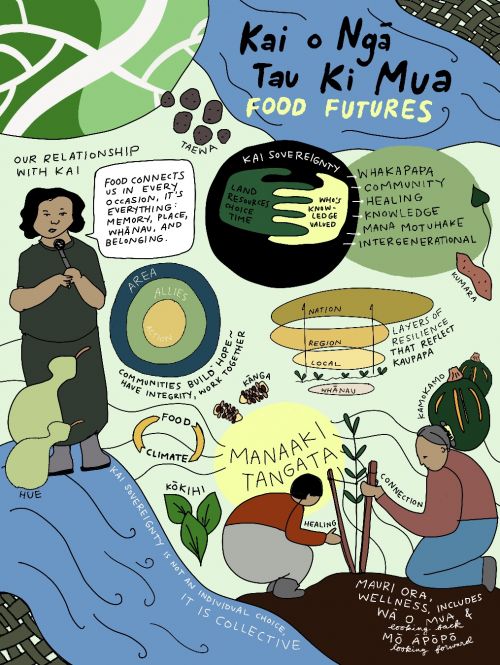
Graphic thanks to Reb @veggiedoodlesoup
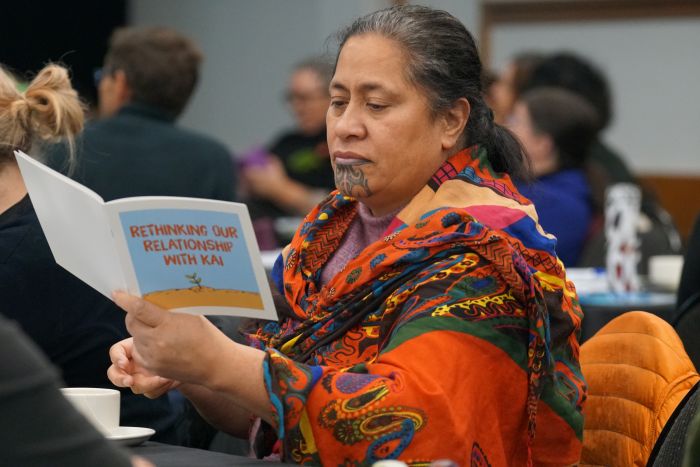
The symposium brought together farmers, growers, researchers, iwi representatives, community organisations, health professionals, local government, educators, students, and community members to consider how we can collectively create a more resilient, equitable, and sustainable food future for the Manawatū and Aotearoa.
The day was grounded in the understanding that kai is far more than a commodity. Speakers and participants reflected on kai as a source of identity, culture, wellbeing, whakapapa, relationships, and collective responsibility. Presentations, local case studies, panel discussions, and an interactive workshop explored the opportunities and challenges facing food systems as climate change, economic pressures, and social inequities reshape how food is produced, distributed, and accessed.
The symposium also acknowledged that food insecurity is a significant issue in the Manawatū. Many whānau experience barriers to accessing affordable, nutritious, and culturally appropriate kai. Food banks, community pantries, and food rescue organisations play an essential role in responding to immediate need and reducing food waste.
However, the primary focus of the symposium was food sovereignty rather than food insecurity alone. Food insecurity asks whether people have reliable access to sufficient and appropriate food. Food sovereignty asks deeper questions about the systems that shape that access: who controls land and resources, who makes decisions about food production and distribution, whose knowledge is recognised, and whether communities have the authority to determine their own food futures.
Rather than seeking agreement on every issue, the symposium created space for respectful dialogue and ongoing collaboration.
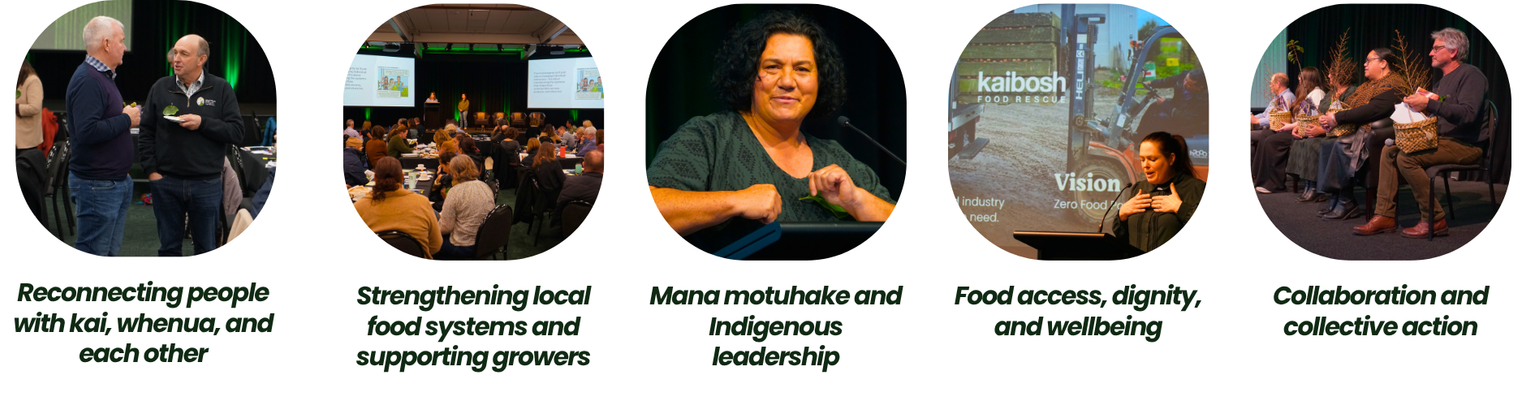
Key themes that came out of the event
Want to relisten?
MPR kindly recorded the whole event and turned it into bite sized chunks for easy listening.
Connect with our Speakers & Panellists
Chrissy Severinsen & Angelique Reweti
Rethinking our Relationship with Kai – Massey University and ENM
Contact Angelique Reweti or Chrissy Severinsen
Emily King
Food Systems and Community – SPIRA
Hina Cheema
PNCC Food Security and Resilience Policy
Pounamu Skelton
Reconnecting Whānau to Whenua: A Mana Whenua Community Perspective
Connect with Pounamu on Facebook
Aleise Puketapu
Mana Whenua Research and Mātauranga Māori – Tahuri Whenua
Ashley O'Neil
Manawatū Regional Food Strategy Overview – CEDA
Andrew Watt
Local Climate Projections – Horizons Regional Council
Rob Hall
Live 2 Give Organics: Regenerative Agriculture in Practice
Panel Discussion
Our panel brought together a range of perspectives from across Aotearoa's food system.
Panellists
-
Victoria Hatton
-
Tobias
-
Roger Robson-Williams
Ira Bailey
Using Technology to Connect Growers to Consumers – Co-shop
Susie Robertson
Second Harvest
Find out more about food rescue initiatives through Just Zilch and Kaibosh
Dr Gabriella Gronqvist
Whenua Haumanu research programme – Massey University
Priority opportunities and actions
Strengthen local coordination
Participants identified an opportunity to build stronger connections between growers, iwi, food rescue organisations, community gardens, health organisations, educators, researchers, local government, and community groups.
Possible actions include:
- mapping existing initiatives, resources, and areas of need;
- creating regular opportunities for groups to connect and share knowledge;
- supporting joint funding applications and collective advocacy; and
- sharing equipment, infrastructure, volunteers, and expertise.
Support practical learning and knowledge sharing
Participants supported more opportunities for community-based learning, including:
open days with local growers;
- workshops on growing, soil health, harvesting, preserving, and cooking;
- mentoring between experienced growers and emerging community gardeners;
- intergenerational learning; and
- opportunities for tamariki to learn about the whakapapa and production of kai.
Improve connections between growers and communities
Participants identified opportunities to shorten the distance between producers and the people they feed through:
- direct producer-to-consumer relationships;
- community-supported agriculture;
- local food hubs and markets;
- stronger systems for redirecting surplus produce;
- increased visibility of locally grown kai; and
- support for growers wanting to supply local communities.
Advocate for supportive policy
Participants highlighted the need for policies that address the structural conditions shaping food systems.
Suggested areas for advocacy included:
- a regional food strategy;
- increased funding for growers and community food initiatives;
- support for regenerative transitions;
- action on food waste and plastics; and
- food-system governance that upholds Te Tiriti o Waitangi and tino rangatiratanga.
Continuing the conversation
Food sovereignty and the export economy
One of the most significant discussions concerned the relationship between food sovereignty and Aotearoa New Zealand’s export-oriented food system.
Participants consistently described food sovereignty as grounded in whakapapa, relationships with whenua, mana motuhake, community wellbeing, local decision-making, and the right of communities to determine how food is produced, shared, and accessed.
Another perspective suggested that strong local food systems and thriving food cultures could strengthen Aotearoa’s international reputation and provide social licence for high-value food exports. From this perspective, food sovereignty and export success could reinforce one another.
While both perspectives seek healthy food systems and thriving communities, they place emphasis in different places.
Food sovereignty emerged as a response to globalised food systems and argues that communities should have the authority to define their own food futures before responding to market demands. Local food systems are therefore valued because they strengthen community authority, cultural continuity, relationships, and wellbeing—not because they enhance export opportunities or national competitiveness.
Many participants were concerned that local food systems, mātauranga Māori, whakapapa, and relationships with whenua could be treated primarily as assets that add value to the export economy.
Participants emphasised that food sovereignty is about authority, tino rangatiratanga, access to land and resources, and the right of communities to determine their own food systems. It asks who makes decisions, whose knowledge is recognised, who benefits, and whose priorities shape the future.
Participants also highlighted the importance of respecting the integrity of mātauranga Māori. Indigenous knowledge should not be incorporated into strategies or commercial narratives without Māori authority and governance. Mātauranga Māori is grounded in whakapapa, whenua, tikanga, relationships, and responsibility, and Māori retain the right to determine how it is governed, shared, and applied.
The symposium did not seek to resolve this tension. Instead, it highlighted the need for continued discussion about what food sovereignty means in the Manawatū and how economic aspirations can be considered alongside Te Tiriti o Waitangi, Indigenous rights, environmental stewardship, and community wellbeing.
Questions for ongoing reflection
The key question: Are local food systems being strengthened so communities can exercise authority over their food futures, or primarily to support the legitimacy and profitability of the existing export system?
The symposium raised several questions that warrant continued discussion.
|
Theme |
Questions for ongoing reflection |
|
Food insecurity and food sovereignty |
How can we respond with dignity to immediate food insecurity while also changing the conditions that prevent communities from exercising authority over their food systems? |
|
Food sovereignty and the export economy |
Can food sovereignty and an export-focused food economy coexist without compromising mana motuhake and community self-determination? |
|
Food as commodity or taonga |
Is kai primarily an economic product, or a relationship grounded in whakapapa, whenua, wellbeing, and mana? |
|
Mātauranga Māori and governance |
What role should mātauranga Māori play in shaping future food systems, and who holds authority over how it is governed, shared, and applied? |
|
Te Tiriti o Waitangi and leadership |
How should Te Tiriti o Waitangi and tino rangatiratanga shape food-system governance and decision-making? |
|
Profit and environmental stewardship |
How can growers remain financially viable while restoring ecological health and caring for whenua? |
|
Local resilience |
Are larger, centralised food systems always more resilient than locally connected, community-based systems? |
|
Knowledge into action |
How do we move from shared ideas to coordinated and sustained action? |
|
Shared responsibility |
What roles can communities, iwi, growers, researchers, industry, and government each play in creating a more resilient and just food system? |
Sponsors



Want to become a sponsor? Email Morri for more info.
 ENM on Facebook